In the 1950s the Center of the Weestern Art World Shifted From Paris to
Contemporary Art
Contemporary art is the overall production of fine art made after World War Two.
Learning Objectives
Differentiate between the categories of late modernism and mail service modernism in art.
Central Takeaways
Central Points
- The predominant term for fine art produced since the 1950s is Contemporary Art. The terminology often points to similarities between late modernism and post-modernism, although in that location are differences.
- Modern fine art, radical movements in Modernism, and radical trends regarded as influential and potentially every bit precursors to late modernism and postmodernism emerged around Globe War I and specially in its aftermath.
- The discourse that encompasses the 2 terms Late Modernism and Postmodern art is used to announce what may be considered every bit the ultimate phase of modern art, every bit art at the cease of modernism or every bit certain tendencies of gimmicky art.
- Late modernism describes movements which arise from and react against trends in modernism and rejects some aspect of modernism, while fully developing the conceptual potentiality of the modernist enterprise.
Cardinal Terms
- Cubism: An early-20th-century avant-garde art movement pioneered by Pablo Picasso and Georges Braque, where objects are analyzed, broken up and reassembled in an bathetic form.
- precursors: That which precedes; a forerunner; a predecessor; an indicator of approaching events.
- Surrealism: An creative motion and an artful philosophy, pre-dating abstract expressionism, that aims for the liberation of the listen by emphasizing the disquisitional and imaginative powers of the subconscious.
Groundwork
The predominant term for art produced since the 1950s is Contemporary Art. Not all fine art labeled 'gimmicky' is modernistic or postmodern, and the term gimmicky encompasses both artists who continue to piece of work in modernist or tardily modernist traditions, too as artists who decline modernism for mail service-modernism or other reasons. Arthur Danto argues explicitly in After the End of Art that contemporaneity is the broader terms, and that postmodern objects stand for a sub-sector of the contemporary movement which replaced modernity and modernism.
Radical movements in mod art
Modern art, radical movements in Modernism, and radical trends regarded as influential and potential precursors to tardily modernism and postmodernism emerged effectually World War I and particularly in its aftermath. With the introduction of the use of industrial artifacts in art came movements such equally Cubism, Dada, and Surrealism also as techniques such as collage and art forms such as movie theater and the rise of reproduction as a ways of creating artworks. Pablo Picasso, Marcel Duchamp, and many others created of import and influential works from found objects.
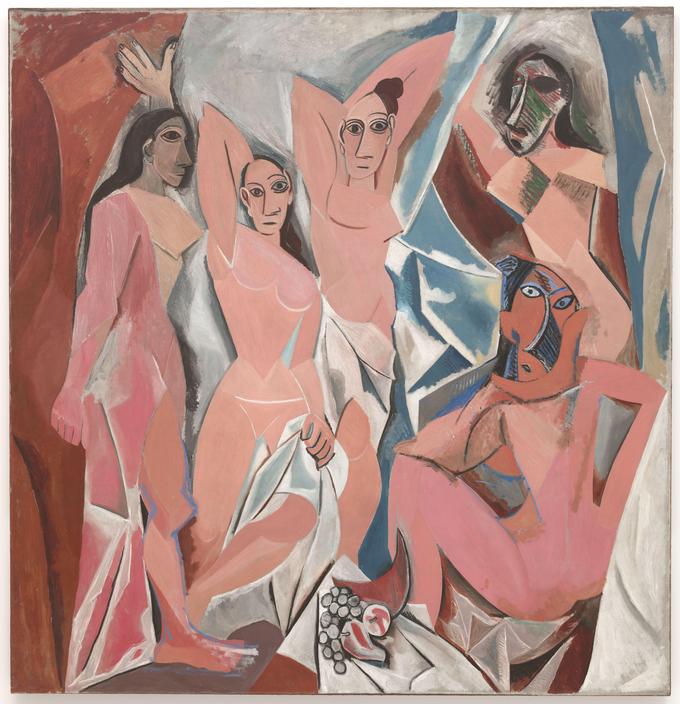
Pablo Picasso, Les Demoiselles d'Avignon, 1907: This work by Picasso is considered to exist a major step towards the founding of the Cubist movement.
Tardily Modernism vs. Postmodernism
The discourse surrounding the terms Late Modernism and Postmodern art is fraught with many differing opinions. There are those who argue against whatsoever division into mod and postmodern periods. Some don't believe that the period called modernism is over or even virtually the finish, and at that place certainly is no understanding that all art after modernism is post-modern, nor that postmodern art is universally separated from modernism; many critics meet it as merely another stage in modernistic art or some other form of belatedly Modernism. There is, still, a consensus that a profound change in the perception of works of art, and works of art themselves, has occurred and that a new era has been emerging on the world phase since at least the 1960s.
Late modernism describes movements which arose from and react against trends in modernism, rejecting some aspect of modernism, while fully developing the conceptual potentiality of the modernist enterprise. In some descriptions post-modernism as a period in art history is completed, whereas in others it is a continuing movement in Contemporary fine art. In art, the specific traits of modernism which are cited generally consist of: formal purity, medium specificity, art for fine art's sake, the possibility of authenticity in fine art, the importance or fifty-fifty possibility of universal truth in art, and the importance of an avant-garde and originality. This last point is 1 of particular controversy in art, where many institutions argue that beingness visionary, forward-looking, cutting edge, and progressive are crucial to the mission of fine art in the present, and that postmodern art therefore represents a contradiction of the value of art of our times.
One meaty definition of postmodernism is that it rejects modernism'due south g narratives of artistic direction, eradicates the boundaries between loftier and low forms of art, disrupts the genre and its conventions with collision, collage, pastiche, and fragmentation. Postmodern fine art comes from the viewpoint that all stances are unstable and insincere, and therefore irony, parody, and sense of humor are the but positions which cannot be overturned by critique or afterward events.
European Postwar Expressionism
Postwar European artists, unlike American abstruse expressionists, grappled with the isolated experience of the individual figure.
Learning Objectives
Contrast European postwar expressionism with contemporary expressionism in America
Fundamental Takeaways
Key Points
- Following the end of WWII and the appearance of American abstract expressionism, the center of western creative activity shifted from Paris to New York.
- Many European artists were heavily influenced by the intellectual movement existentialism. This involvement is reflected in their attempts to grapple with the meaning of the isolated figure in the postwar globe.
- The closest equivalents to American abstract expressionism were the French painting movements Tachisme and Art Informel. The artistic approach of these movements was characterized by intuitive brainchild and abandonment of premeditated structure.
Key Terms
- existentialism: A twentieth-century philosophical motion emphasizing the uniqueness of each human existence in freely making self-defining choices. This move had foundations in the thought of Søren Kierkegaard (1813-55) and Friedrich Nietzsche (1844-1900) and was notably represented in the works of Karl Jaspers (1883-1969), Gabriel Marcel (1887-1973), Martin Heidegger (1889-1976), and Jean-Paul Sartre (1905-80).
- Surrealism: An artistic movement and artful philosophy that aims for the liberation of the listen by emphasizing the critical and imaginative powers of the hidden.
In the Postwar catamenia, the eye of modern artistic activeness in the westward shifted from Paris to New York. Ane of the biggest contributing factors to this shift was the advent of abstract expressionism, a decidedly American move often cited as the kickoff American avant-garde. Visionary figures like Jackson Pollock, Mark Rothko, and Barnett Newman epitomized abstract expressionism in New York, only a similar business for expressionism was nowadays in the work of many important European artists in the aftermath of World War II.
The Postwar Figure
While both American and European artists were influenced by the postwar rhetoric of anxiety, alienation, and disillusionment, the American school was also heavily influenced by Surrealism and moved increasingly toward reductive abstraction and away from representing biomorphic forms as a means for pursuing the self-expression of the unconscious.
Different American Expressionism, which was more abstruse, many European painters maintained the primacy of the figure in their work. More than concerned with the philosophical and cultural movement of Existentialism, European artists grappled with the meaning of the figure and its isolated, private experience of the world. Existentialist themes oftentimes framed the piece of work of figurative artists such as Francis Bacon, Lucian Freud, and Alberto Giacometti. Salary and Freud were British painters who painted expressive portraits noted for their psychological penetration. Giacometti was a Swiss painter and sculptor mostly known for his sculptures of isolated, adulterate figures. These figures were idea to reflect the postwar view that life was void of significant.
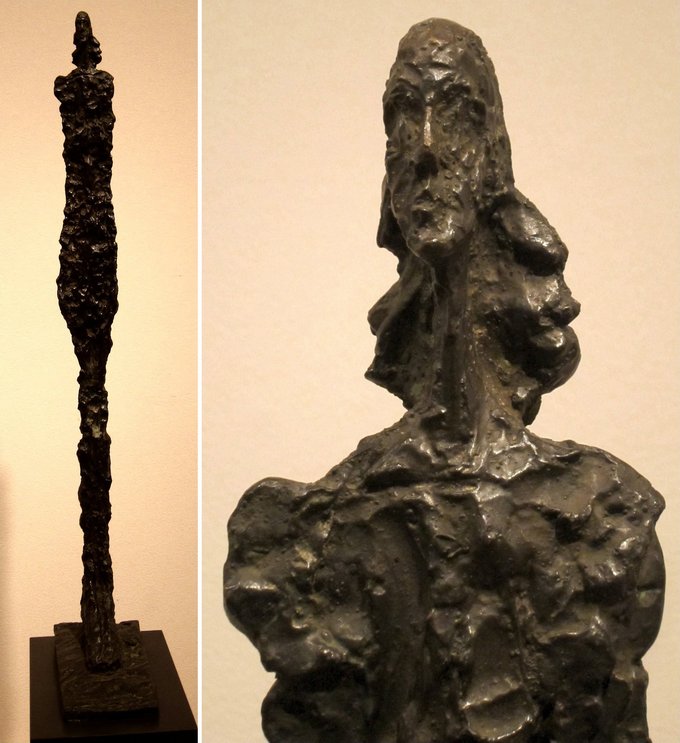
Alberto Giacometti, Adult female of Venice VII, 1956, bronze. Fine art Gallery of New Southward Wales.: Giacometti's "Woman of Venice VII" presents the typical solitary effigy often seen in his work, which was heavily influenced by existentialist thought.
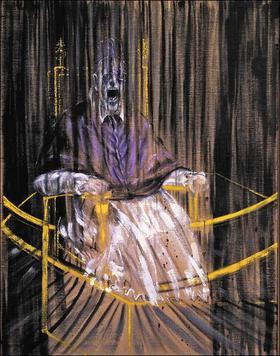
Francis Bacon, Study afterward Velazquez's Portrait of Pope Innocent 10, 1953, oil on canvas, 60 10 46 in. De Moines Art Eye, De Moines, Iowa.: This painting by Bacon exemplifies a figurative portrayal of existential and individual angst that European Expressionists typically display in their work.
Tachisme/Art Informel
During this flow, European artists engaged more fully in brainchild, particularly those associated with the French painting movements Tachisme (from the French word tache, pregnant stain) and Art Informel. Tachisme is ofttimes regarded as the closest European equivalent to American abstract expressionism, and tin can be characterized past spontaneous brushwork, drips and blobs of paint applied directly from a tube, and, occasionally, scribbling reminiscent of calligraphy. Important Tachisme painters include Jean-Paul Riopelle, Jean Dubuffet, Pierre Soulages, Nicholas de Stael, Hans Hartung, Serge Poliakoff, Georges Mathieu, and Jean Messagier. Fine art Informel, a movement closely related to Tachisme, rejected the geometric, hard-edge style of American abstraction in favor of a more intuitive form of expression. "Informel" referred to the lack of form itself and the absence of a premeditated structure.
Source: https://courses.lumenlearning.com/boundless-arthistory/chapter/the-world-since-1950-ce/#:~:text=In%20the%20Postwar%20period%2C%20the,the%20first%20American%20avant%2Dgarde.
Post a Comment for "In the 1950s the Center of the Weestern Art World Shifted From Paris to"